How Much Does Landscape Lighting Cost? A Straight Answer for Homeowners
If you're reading this, you probably want one thing: an honest number. Not an "it depends" that leaves you more confused than when you started, and not a vague range so wide it's useless.
So here it is, upfront:
- Basic system (4–6 fixtures): $2,500 – $3,500
- Medium system (8–15 fixtures): $4,000 – $7,500
- High-end system (20+ fixtures with zones and smart controls): $8,500 – $20,000+
Those ranges are real. They reflect actual installed costs for residential landscape lighting in Canada, including materials, labour, and everything that goes into a proper installation.
Now — if you want to understand where your project is likely to land in those ranges, and why two similar-looking properties can come in at very different prices, read on. The factors below are the ones that actually move the needle.
Your Property and the Scope of Work
The starting point is always the property itself. A compact residential yard with straightforward access is a very different project from a large estate, an acreage, or a commercial property — and the cost reflects that.
New construction projects can also be meaningfully less expensive to wire than existing properties, simply because the landscaping isn't in yet. Running cable through fresh soil before the sod goes down is a lot easier than trenching through an established lawn or routing conduit underneath an existing driveway. If you're building or doing a major landscaping renovation, that's a good time to think about lighting.
What You're Trying to Accomplish
This matters more than most people expect, and it has a significant effect on cost.
If your main goal is safety and function — well-lit pathways, a well-lit front entrance, basic coverage — there are cost-effective ways to get there. The design doesn't need to be complex, and the fixture count can stay low.
If your goal is to make your property look genuinely beautiful at night — with layering, depth, highlighted trees, architectural features, and a design that looks considered rather than generic — that takes more fixtures, more design work, and more installation time. It's worth it, but it costs more.
Being honest with yourself about which category you're in makes it easier to evaluate quotes accurately. A contractor who doesn't ask what you're trying to achieve before writing a number isn't designing for your goals.
For larger or more complex projects, working with a lighting designer upfront adds real value. A good designer will help you avoid expensive mistakes and create a result that looks intentional rather than assembled piece by piece. That design expertise has a cost, but it typically saves money in the long run by getting it right the first time.
The Fixtures: What You're Actually Installing
Landscape lighting fixtures exist at essentially every price point, and the difference between a budget fixture and a quality one is significant — it just doesn't always show up right away.
Integrated vs. Drop-In Fixtures
This is a distinction worth understanding before you compare quotes.
Integrated fixtures have the LED built directly into the fixture. They're generally more efficient, more durable, and longer-lasting. The tradeoff is a higher upfront cost and the fact that when the LED eventually reaches end of life, you replace the fixture rather than just the bulb.
Drop-in fixtures use replaceable bulbs. They cost less initially and give you flexibility to upgrade bulb technology as it improves. The tradeoff is higher maintenance costs over time and, in many cases, shorter overall lifespan.
Neither is universally right or wrong — it depends on your priorities and budget. What matters is that you understand which type you're being quoted, and why.
Housing Material
The material your fixture is made from determines how long it holds up outdoors — and outdoor conditions are demanding. Rain, snow, UV exposure, temperature swings, and general wear all take a toll.
At the lower end, you'll find plastic and thin stamped aluminum fixtures. At the higher end: solid brass, copper, stainless steel, and higher-grade aluminum. The premium materials are more durable, handle Canadian winters better, and maintain their appearance over time. Brass and copper will even develop a patina that most people find more attractive than the original finish.
This isn't a pitch for the most expensive option — it's context for why two quotes with the same fixture count can look very different in price.
Lighting Technology: From Basic to Smart
The technology in your system affects both the upfront cost and the long-term experience.
Entry-level systems use basic low-voltage LED fixtures. They're cost-effective, energy-efficient, and reliable for functional applications — pathway lighting, basic garden accents, front entry coverage.
Mid-range systems step up to integrated LED fixtures with better optics, improved weather resistance, and longer warranties. This is the sweet spot for most residential projects that prioritize both performance and longevity.
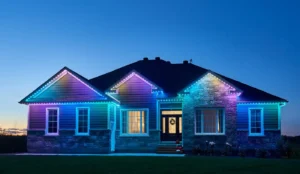
High-end smart systems add app or voice control, programmable scenes, RGB colour-changing capability, and zone-by-zone dimming. If you want to set the mood for an outdoor dinner, adjust your lighting from your phone, or have your system respond to the seasons without going outside, this is where those features live. The experience is genuinely different — and the cost reflects the complexity.
Installation: The Part That's Hard to Predict From the Outside
Every property has its own installation quirks, and this is one of the main reasons an accurate quote requires an actual site visit.
Ground conditions matter. Lush soil that's easy to trench is a very different situation from rocky ground or existing hardscape. Access to power matters too — both where your transformer can be installed and what cable gauge is needed to carry adequate voltage to your fixtures. (The further the distance between the transformer and the fixture, the heavier the wire required, and the higher the material cost.)
Labour can also look very different from one project to the next. A straightforward installation might involve a few hours of work and a clean finish. A project with a moonlighting fixture hung sixty feet up in a tree — which often requires a contracted arborist — is a different day entirely. Some projects also require a return visit for night aiming: properly aiming downlights and spotlights can only be done accurately in the dark. It sounds obvious, but not every installer does it, and the difference in the final result is noticeable.
Depending on the age of your home, you may also need to run a new dedicated electrical circuit to support the transformer. That's a real cost that should show up in your quote, not appear as a surprise.
Maintenance and Long-Term Costs
This section deserves more attention than it usually gets.
LED fixtures last a long time — but a landscape lighting system isn't a "set it and forget it" investment. Over time, wires can be nicked by lawn equipment or pushed up by frost heave, fixtures get bumped out of alignment, plants grow around and sometimes over them, and transformer connections can work loose. We've walked properties where systems installed years earlier had never been touched, and the state of disarray was significant: buried fixtures, dead zones, cut wires, and transformer boxes that had essentially become insect condominiums.
A maintenance plan that includes annual fixture cleaning, wire checks, voltage testing, and re-aiming keeps your system performing the way it did when it was new. It also ensures that any warranty issues — which are often time-sensitive — get caught and addressed before the window closes.
Think of it less like a one-time purchase and more like a car: the better you maintain it, the longer and better it performs.
What a Quote Should Actually Tell You
Before you sign anything, make sure you understand what's included:
- Are these integrated or drop-in fixtures?
- What are the fixtures made of, and who manufactures them?
- What's the warranty on fixtures and on the installation?
- Does the quote include night aiming?
- Is there a maintenance plan available, and what does it cover?
- What happens if additional work is needed once installation begins?
A contractor who can answer these questions clearly is one who knows what they're doing. One who gets vague is telling you something important.
The Bottom Line
Landscape lighting is one of the home investments that people most consistently say they wish they'd done sooner. But like any significant investment, it goes better when you go in informed.
Use the ranges above as a starting point. Use the factors in this article to understand where your project is likely to land. And use the questions at the end to make sure any quote you receive tells you what you actually need to know.
If something still isn't clear, keep asking. A company that's worth hiring will never make you feel like your questions are an inconvenience.