Tree Lighting: Uplighting vs. Moonlighting | Victoria BC
Mature trees can become some of the strongest nighttime features on a property. Learn when to use uplighting, moonlighting, or both.
Read more

adam
Co-Owner
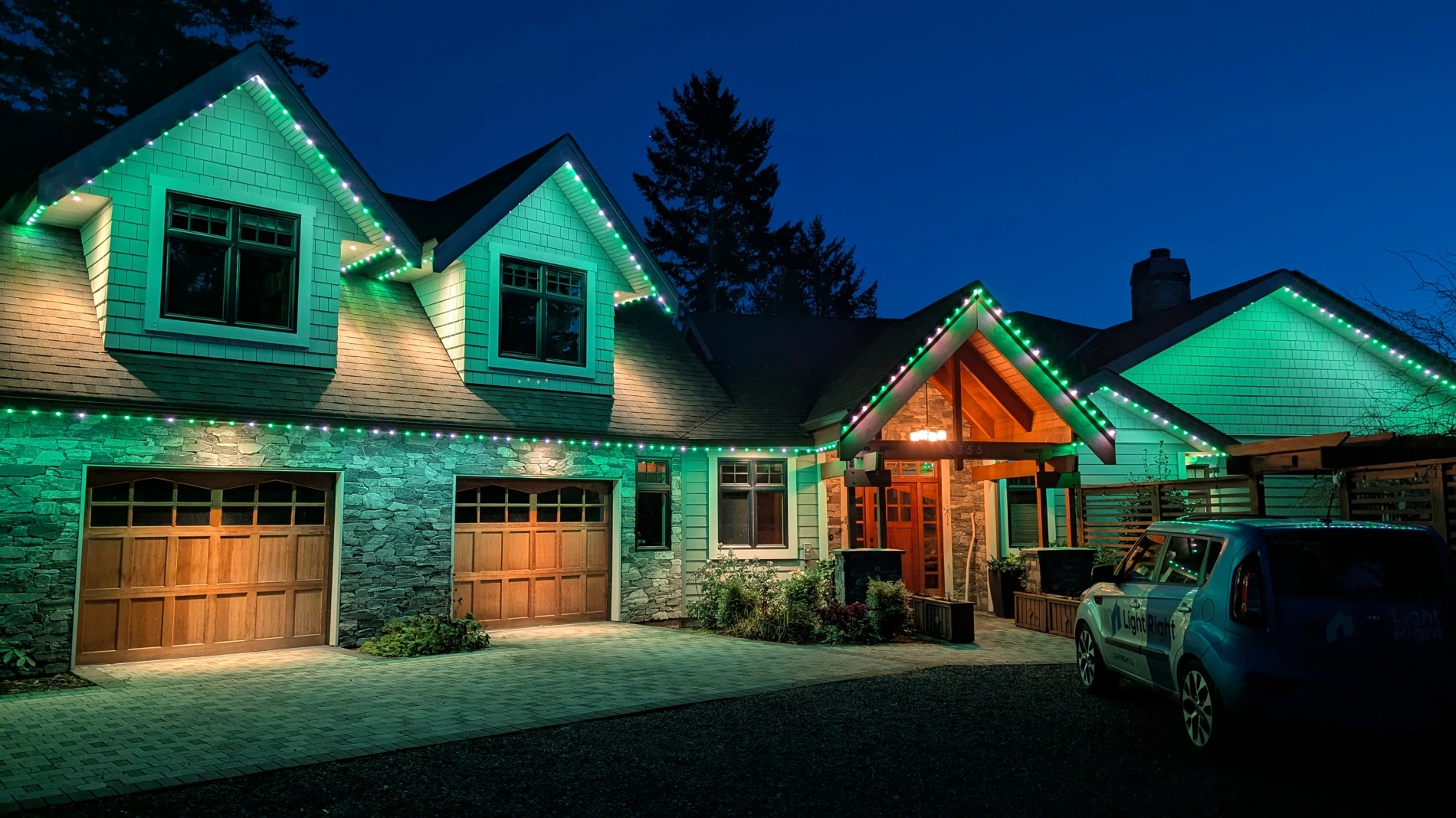
If you've started looking into permanent holiday lighting comparisons, you've probably already noticed something: there are a lot of options, a wide range of prices, and not much straightforward information to help you compare them.
This article is an attempt to fix that. We'll walk through the three most common professional permanent lighting systems — Celebright, Gemstone, and Trimlight — compare them honestly on the specs that actually matter, and give you a fair look at DIY as well. If one of these options turns out to be the right fit for you, great. If a different one is, that's great too.
Before comparing systems, it helps to understand what you're actually buying.
Permanent holiday lighting — sometimes called soffit lighting or architectural lighting — consists of LED pixel lights mounted along the roofline, soffit, or eaves of your home. Unlike traditional holiday lights that you hang and take down every year, permanent systems are installed once and stay in place year-round. They're weatherproof, low-profile, and controlled through an app that lets you change colours, set schedules, and run animations on demand.
The result is that you get holiday lighting every season without the annual setup and takedown — and the system is discreet enough that it doesn't look out of place the rest of the year.
Here's the honest answer: these three systems are more similar than their marketing materials would suggest. All three use high-quality LED components, all three are app-controlled, all three are professionally installed, and all three are built to last. If you received quotes from contractors representing each of these brands, you would not be making a bad decision with any of them.
That said, there are real differences worth understanding.
All three systems are designed for permanent outdoor exposure, but their IP (Ingress Protection) ratings differ slightly. Celebright and Trimlight carry an IP68 rating — the highest available, meaning the fixtures are fully dust-tight and can withstand continuous submersion in water. Gemstone carries an IP67 rating, which is also excellent and more than sufficient for typical weather conditions, but represents one
step down on the submersion scale.
In practical terms, this difference is unlikely to matter for most Canadian homeowners. Both ratings handle rain, snow, and ice effectively. But if you're comparing specs directly, IP68 is the higher standard.
This is where the differences become more meaningful — particularly on the labour side.
Celebright and Gemstone both offer 10-year parts warranties. Trimlight claims a lifetime warranty on parts, which sounds impressive, but the labour warranty is only one year — the same as Gemstone. Celebright's three-year labour warranty is the strongest of the three.
Why does the labour warranty matter? Because if a fixture fails or a connection works loose in year two, a parts warranty alone doesn't cover the cost of someone coming out to fix it. The labour warranty is what actually protects you from out-of-pocket service costs in the early years of your system.
Celebright is fully vertically integrated, meaning they design and manufacture every component of their system in-house rather than assembling parts from various suppliers. Their fixtures use a compact 20mm frosted bulb engineered for brightness and efficiency, and the entire system runs on 24V — low enough that 100 lights use less energy than a single 60W bulb.
Gemstone and Trimlight source components through their supply chains rather than manufacturing everything themselves. This doesn't mean their products are inferior — both are well-regarded professional systems — but it does mean Celebright has a higher degree of control over consistency and quality from one component to the next.
All three systems use LED bulbs with a rated lifespan of 50,000 hours — roughly 20 years at typical usage levels. Beyond that shared baseline, there are a few differences worth knowing about, though it's worth noting that these specs come from each company's own marketing materials rather than independent testing.
Celebright uses a 20mm frosted RGBW bulb — RGB plus a dedicated white LED — and specifies a 90+ CRI (Colour Rendering Index). CRI measures how accurately a light source renders colours compared to natural light; a 90+ rating is genuinely high quality and translates to light that looks richer and more true-to-life. This is the one bulb spec that has a visible, real-world impact and is worth paying attention to.
Gemstone uses RGBWW LEDs — RGB plus a dedicated warm white — rated at 2800K, which produces a softer, amber-toned white rather than a neutral or cool one. This is a meaningful distinction if the warmth of your white light matters to you aesthetically.
Trimlight offers two bulb options: the Classic, which uses a single LED per bulb, and the 3L, which houses three LEDs per bulb for increased brightness. Both run on a 12V system, compared to Celebright's 24V. Trimlight argues that 12V is advantageous for heat dissipation and long-term performance; Celebright positions 24V as more efficient. Both companies present their voltage choice as a strength, so this particular spec debate generates more heat than light — the practical difference for a homeowner is subtle at best.
The honest summary: if light quality and colour accuracy matter to you, Celebright's 90+ CRI is the most meaningful bulb spec in this comparison. If the warmth of your white setting is a priority, Gemstone's dedicated 2800K warm white is worth noting. For sheer brightness, Trimlight's 3L option has an edge.
All three systems are app-controlled and offer comparable functionality: colour selection, scheduling, animations, and scene programming. None of the three stands out meaningfully over the others in day-to-day usability. You'll be able to set your lights to run automatically on a schedule, change them for different holidays, and adjust them from your phone.
Here's something most companies in this industry won't tell you: for the majority of homeowners, the differences between these three systems are less important than the contractor installing them.
A well-installed Gemstone system will outperform a poorly installed Celebright system every time. The lights will sit straighter, the connections will last longer, the system will perform the way it's supposed to, and when something needs attention years down the road, someone will actually show up.
The questions worth spending time on aren't just "which brand?" — they're:
A permanent lighting system is something you'll look at every day. The craftsmanship of the installation shows.
DIY permanent lighting kits are widely available online, and the price difference compared to a professional installation is real. If you're considering this route, here's an honest look at what to expect.
DIY can be a good fit if:
Where DIY commonly falls short:
The most frequent complaints we hear from homeowners who've tried a DIY system before calling a professional:
The installation is harder than it looks. Working at roofline height for hours is physically demanding and uncomfortable in a way that's hard to appreciate until you're doing it. Many people underestimate this significantly.
The mounting doesn't hold. Consumer DIY kits often rely on adhesive clips rather than proper mechanical fasteners. In Canadian climates — with freeze-thaw cycles, ice, and wind — adhesive mounting frequently fails within a season or two.
The lights don't run straight. Getting a consistent, clean line of lights along a roofline requires the right tools, experience, and patience. Without those, the result can look noticeably uneven, which is something you'll see every time you pull into your driveway.
Maintenance falls on you. When a section stops working, when a clip pulls away, when the app loses connection — that's your problem to solve. There's no contractor to call.
None of this means DIY is the wrong choice for everyone. It means going in with accurate expectations is important. If you're handy, patient, comfortable on a ladder, and treating it as an ongoing project rather than a one-time install, it can work well.
One factor that's easy to overlook when comparing quotes is the complexity of your specific roofline.
Professional installers refer to "jumps" — breaks or gaps in the lighting run caused by architectural features like gables, dormers, garage door openings, or other structural elements. Each jump requires additional wiring, connectors, and careful attention to keep the installation looking clean and professional. A home with a complex roofline will simply take more time and material than a simpler one, and that's reflected in the cost.
When getting quotes, make sure the contractor has walked your home and accounted for its specific architecture — not just its linear footage. A quote based on a rough measurement without a proper site assessment is likely to change.
Regardless of which system you're considering, these questions will help you separate contractors who take their work seriously from those who don't:
A contractor who installs permanent lighting well is proud of their work and will welcome these questions. One who gets evasive is telling you something.
Celebright, Gemstone, and Trimlight are all legitimate, high-quality systems. The real differences — IP rating, warranty terms, and manufacturing approach — are worth understanding, but they're unlikely to be the deciding factor in whether you end up happy with your permanent lighting.
What will determine that is the quality and integrity of the company installing it.
If your priority is budget and you're comfortable with the physical realities of the job, DIY is a reasonable path. If you want a clean, professionally installed system with meaningful warranty coverage and someone to call when you need service, a professional installation is worth the investment.
Either way, the goal is the same: a home that looks exactly the way you want it to, every season, for years to come.
If you're ready to dig into what a professional installation actually costs, our guide to permanent holiday lighting pricing breaks down the factors that affect your final number.