Tree Lighting: Uplighting vs. Moonlighting | Victoria BC
Mature trees can become some of the strongest nighttime features on a property. Learn when to use uplighting, moonlighting, or both.
Read more


Joshua Julien
Owner and Lighting Designer
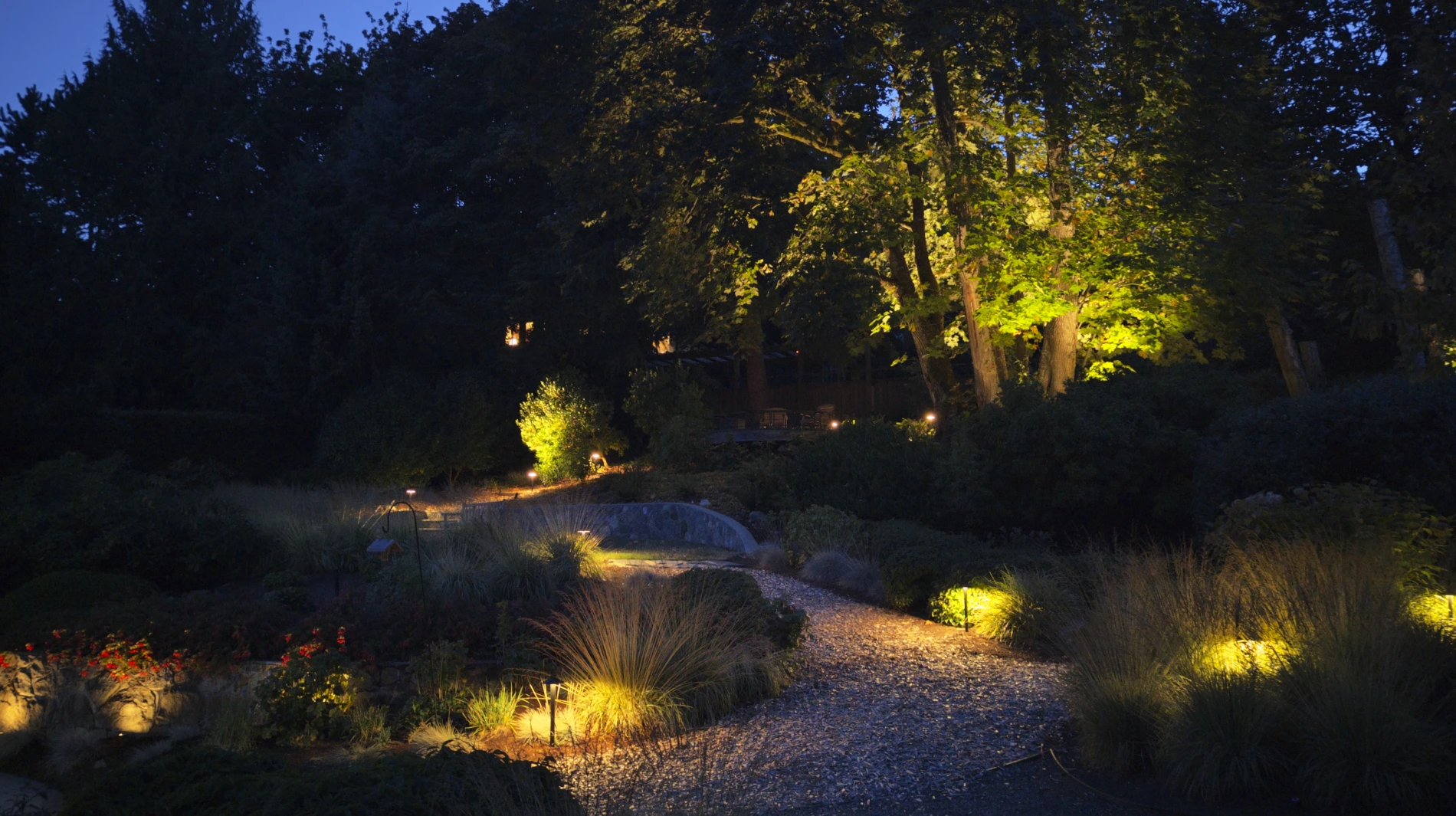
DIY landscape lighting can absolutely make sense.
If you have a small garden, a short pathway or a few simple areas you want to illuminate, a basic low-voltage system may be a perfectly reasonable weekend project.
The difference is that professional landscape lighting is not just about getting fixtures into the ground and making them turn on.
A professional system also considers beam angles, glare, voltage drop, fixture quality, transformer sizing, cable routing, serviceability, nighttime aiming and how the entire property looks together after dark.
So the real question is not whether DIY landscape lighting works.
It is where DIY makes sense and where professional design and installation start to add real value.
DIY can be a good option when the project is small and straightforward.
For example, you may be able to handle the project yourself if you want to light:
Modern low-voltage landscape lighting systems can be relatively approachable.
You do not need to be a professional lighting designer to create a pleasant effect with a handful of well-placed fixtures.
The challenge usually begins when the property becomes larger, the installation becomes more complex or you want the lighting to feel like one complete design rather than a collection of individual lights.

The biggest difference is usually design.
DIY projects often begin with fixtures.
A homeowner might decide they want six path lights, four uplights and a transformer, then figure out where to place everything.
Professional landscape lighting usually works in the opposite direction.
We start with questions like:
Once we understand those things, we can decide what fixtures the design actually needs.
The fixture count comes after the design, not before it.
This is one of the easiest places for DIY lighting to go wrong.
It is natural to place fixtures where there is an obvious physical location for them.
That does not necessarily mean it is the best lighting position.
An uplight pushed directly against the base of a tree may create a harsh hotspot on the trunk.
A path light placed too close to the walkway may shine directly into someone’s eyes.
Two lights spaced evenly on opposite sides of a walkway can create the familiar runway effect.
Moving a fixture by only a few feet can completely change the result.
This is why good landscape lighting often looks simpler than it actually is.
Many DIY lighting decisions focus on brightness.
How many lumens does the fixture have?
How many watts is the lamp?
Those numbers matter, but they do not tell you what the light will actually look like.
Beam angle determines how the light spreads.
A narrow beam can work beautifully on a tall trunk or architectural column. A broad canopy may need a much wider distribution or multiple fixtures.
If the beam is wrong, simply adding more brightness often makes the problem worse.
You can learn more about this in our guide to choosing the right landscape lighting fixtures.
A fixture can illuminate the correct object and still produce an uncomfortable result.
That usually happens when the light source is visible from a normal viewing position.
You may not notice the issue while standing beside the fixture during installation.
However, walk twenty feet away or look through a living-room window and the fixture may suddenly shine directly toward you.
Professional design considers those sightlines.
Shielding, fixture position, mounting height and aiming all play a role.
The goal is to see the effect of the light without constantly seeing the source.
Low-voltage lighting systems require a transformer.
At first glance, sizing one seems simple.
Add up the wattage of the fixtures and buy a transformer with enough capacity.
That is part of the equation, but larger systems require more planning.
We also consider:
A small DIY system close to a transformer may be very forgiving.
Once cable runs get longer or fixture counts increase, system layout starts to matter much more.
Voltage drop becomes more important as cable runs get longer and loads increase.
If a system is poorly planned, fixtures at the end of a long run may not receive the same voltage as fixtures closer to the transformer.
That can affect output and performance.
The solution is not always simply using larger wire.
Sometimes the better answer is changing the cable layout, dividing loads differently or placing another transformer elsewhere on the property.
This is one reason large properties should be designed as systems rather than one long chain of fixtures.

Landscape lighting lives in a difficult environment.
Connections may spend years around moisture, soil, irrigation, mulch and changing temperatures.
A connection can look perfectly fine on installation day and become the weakest point in the system later.
Professional installation should use connection methods designed for long-term outdoor use.
This is also one of the issues we cover in what can go wrong with landscape lighting.
A better fixture can absolutely improve a system.
Construction quality, seals, optics, materials, LED quality, serviceability and warranties all matter.
However, buying an expensive fixture does not guarantee a good lighting design.
A premium fixture with the wrong beam angle in the wrong position is still the wrong fixture.
Likewise, a straightforward professional fixture can produce an excellent result when it is well chosen and correctly positioned.
That is why we do not believe there is one brand or one fixture technology that is automatically right for every property.
Open garden beds are one thing.
Concrete, paving stones, retaining walls and finished hardscape are another.
Lighting those areas may require:
Mistakes become much harder to fix after a surface is finished.
If you are building or renovating, planning the lighting before the hardscape goes in can save a lot of trouble later.
Lighting a small tree from the ground can be a reasonable DIY project.
Mounting fixtures high in mature trees is different.
Tree-mounted downlights can create one of the most beautiful effects in landscape lighting.
When positioned correctly, they cast light through branches and foliage to create natural shadows on the ground below.
However, the work involves more than choosing a light and putting it in a tree.
You need to consider mounting, cable routing, aiming, glare, tree growth and safe access.
Some installations may also require specialized climbing equipment or a professional tree climber.
You can install landscape lighting during the day.
You cannot fully design it during the day.
Once darkness falls, you begin to see what the fixtures are actually doing.
A tree may be too bright.
One beam might spill onto a bedroom window.
A path light may be creating glare.
Another fixture may need to move several feet to reveal a branch structure properly.
This is why we place so much importance on nighttime aiming.
A lighting system is not finished just because every fixture turns on.
We explain that process in more detail in our guide to what to expect from a professional landscape lighting installation.
This is worth saying clearly.
DIY does not automatically mean poor lighting.
Someone who takes the time to learn, experiments with fixture positions and evaluates the property at night can create a very nice result.
In fact, a small thoughtful DIY system can look better than a poorly designed professional installation.
The difference is usually how much complexity you are taking on.
A six-fixture garden project is very different from a 60-fixture property with multiple transformers, mature trees, recessed driveway lights and several lighting zones.
Professional design becomes more valuable as the property or the goal becomes more complex.
It tends to make the most sense when you have:
At that point, you are no longer just buying fixtures.
You are designing a complete nighttime environment.

You can purchase better-quality fixtures without hiring a professional installer.
That can be a good middle ground for some homeowners.
However, professional-grade hardware does not automatically solve design issues.
You still need to determine:
The equipment is only one part of the result.
Usually, yes.
If you provide the labour yourself and use less expensive equipment, a DIY installation can cost substantially less up front.
Professional lighting includes more than fixtures and cable.
You are also paying for design, professional equipment, installation labour, specialty work, system planning, nighttime aiming and ongoing support.
That difference becomes more significant as the property gets larger.
The question is whether you are comparing two ways to achieve the same result.
Often, you are not.
A simple DIY system and a professionally designed whole-property system may technically both be called “landscape lighting,” but they can be completely different projects.
For a better idea of what professional work can cost, read our guide to landscape lighting costs in Victoria, BC.
Yes.
In many cases, an existing low-voltage system can be improved.
That might involve changing fixtures, correcting connections, replacing the transformer, changing cable layouts or redesigning certain areas.
Sometimes the best approach is to keep parts of the existing system and rebuild the areas that are causing problems.
Other times, starting fresh makes more sense.
It depends on the quality and condition of what is already there.
There is no universal line.
However, I would generally feel much more comfortable recommending DIY for a small, accessible and relatively simple garden project than for something involving major hardscape, mature trees or a large property.
A useful way to think about it is this:
If you can easily move a fixture, change your mind and try again, DIY carries relatively little risk.
If the decision involves drilling concrete, climbing a mature tree, planning long cable runs or building around finished construction, getting it right the first time matters much more.
That depends on what you want from the property.
If your goal is simply to add a little visibility around a pathway, a professional system may be more than you need.
If you have invested significantly in architecture, landscaping and outdoor living spaces, professional lighting can extend that investment into the evening.
It can also create something that is difficult to achieve by simply adding fixtures one at a time.
We go deeper into that question in Is Professional Landscape Lighting Worth It in Victoria, BC?.
DIY landscape lighting has a place.
For small and simple projects, it can be affordable, enjoyable and completely appropriate.
Professional landscape lighting becomes more valuable when the design, property or installation becomes more complicated.
The biggest difference is not that professionals have access to lights that homeowners cannot buy.
The goal is not to use more fixtures. It is to use the right light in the right place.
If you want to understand how we approach a project from the initial site walk through installation and nighttime aiming, read what to expect from a professional landscape lighting installation.
At Light Right, we design and install professional landscape lighting throughout Greater Victoria and Vancouver Island.
If you have a small DIY system and simply need some advice, that may be all you need.
If you are planning something larger, we can walk the property, identify the opportunities and design a system around how you actually want the property to feel after dark.