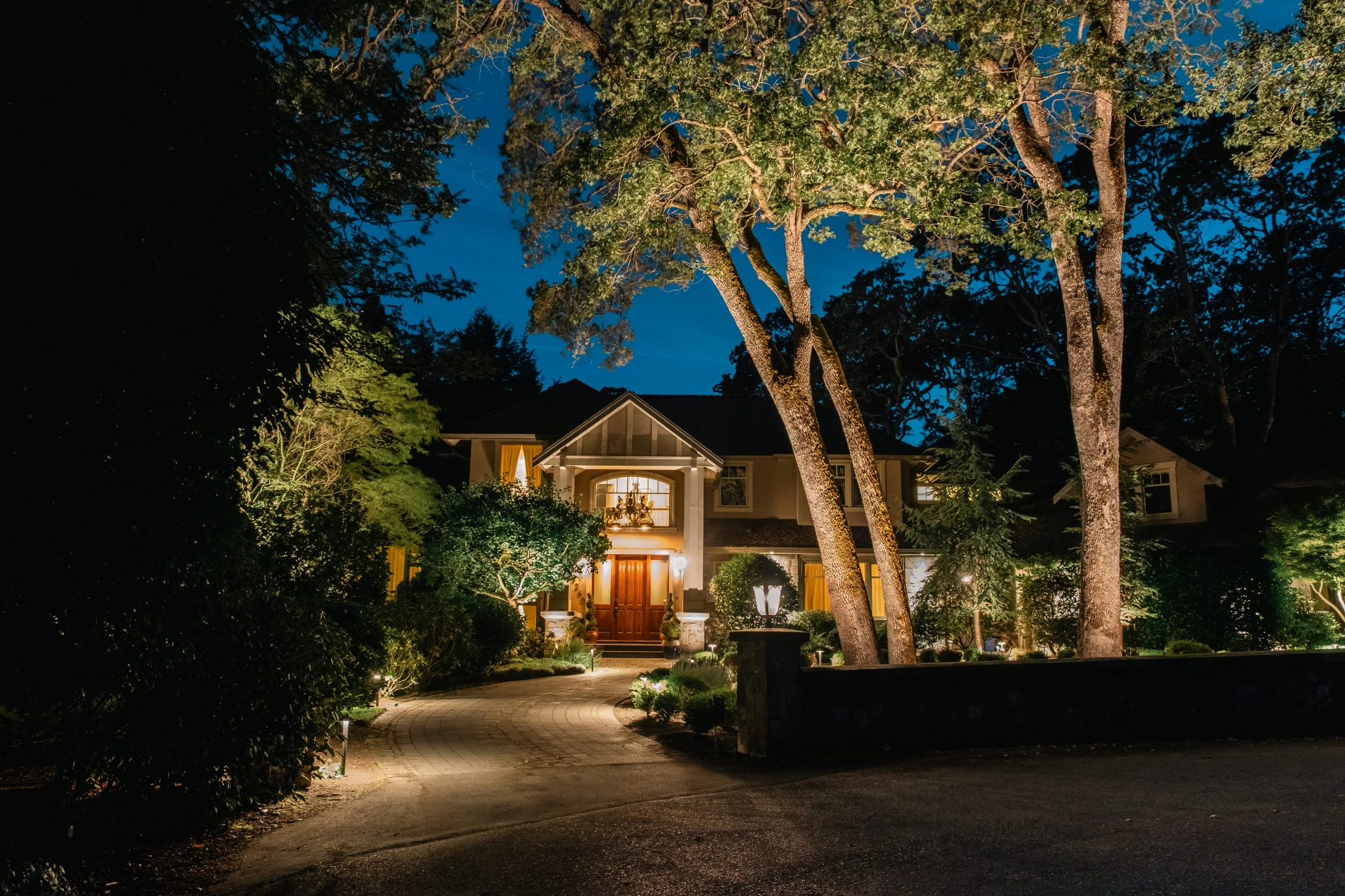
Mature trees are one of the best opportunities in landscape lighting because they give us height, structure and depth. But the way we light a narrow fir is completely different from how we would approach a broad oak or arbutus.
Fixture position, beam angle and viewing direction all affect the result. We also need to think about how the tree will look from inside the home, not just from the driveway.
The goal is to reveal the tree, not the fixture.
What Is Uplighting?
Uplighting places the fixture at or near ground level and aims the light upward into the trunk, branches or canopy. It is one of the most common ways to light trees because it can create strong shape and drama without requiring a fixture to be mounted in the tree.
The effect depends heavily on where the fixture sits. A light placed very close to the trunk may emphasize bark texture and create a strong vertical effect. Moving the fixture farther away can reveal more of the canopy and create a softer overall result.
Beam angle matters too. A narrow beam can work beautifully on a tall trunk or narrow tree, while a broader canopy may need a wider optic or several fixtures working together.
What Is Moonlighting?
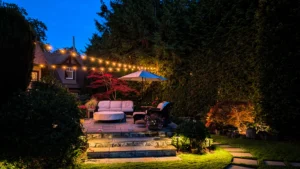
Moonlighting uses a downlight mounted high in a mature tree and aims the light downward through branches and foliage. When it is done well, the shadows from the canopy fall across the ground and create a much more natural effect than a fixture shining straight down from a building.
We may mount these fixtures roughly 25 to 30 feet high depending on the tree, access and the effect we are trying to create. The exact height is less important than getting the fixture into a position where the branches can shape the light naturally.
Shielding is important. If you can stand in the garden and look up directly into a bright light source, the effect starts to fall apart.
Which Is Better: Uplighting or Moonlighting?
Neither one is automatically better.
Uplighting is usually easier to install and service. It can create a strong architectural effect on a trunk and canopy, and it works on a much wider range of trees.
Moonlighting is more subtle. It can create beautiful shadows across lawns, pathways and garden beds while keeping the light source high and out of normal sightlines.
On some properties, we use both. An uplight may reveal the structure of a tree while a downlight in the canopy creates usable light on the ground below.
The Shape of the Tree Should Decide the Technique
A tall narrow conifer and a broad mature oak should not be lit the same way.
A narrow tree may only need one or two carefully aimed uplights. A large spreading canopy may need several fixtures from different angles so the tree has depth instead of looking flat from one direction.
Arbutus trees can be especially interesting because of their trunk colour, branching structure and open canopy. In many cases, the goal is not to blast the entire tree with light. It is to reveal enough of the trunk and branches that the tree still feels natural after dark.
Beam Angle Matters More Than Brightness
Homeowners often compare fixtures by lumens or wattage first, but beam angle can have just as much impact on the finished result.
A narrow beam concentrates light into a smaller area. A wider beam spreads the output across more of the canopy. If the optic is wrong, adding more brightness usually does not solve the problem.
For tree lighting, we choose the beam based on the size of the trunk, canopy width, fixture distance and the viewing angle. You can read more about that in our guide to choosing the right landscape lighting fixtures.
Avoiding Glare
Tree lighting can look amazing from one direction and terrible from another if glare is not considered.
This is particularly important around driveways, patios, bedroom windows and large areas of glass. A ground-mounted uplight that disappears from the street may shine directly toward someone sitting inside the living room.
That is why we evaluate the fixture from normal viewing positions. Shielding, fixture angle and placement often matter more than simply reducing the output.
What About Lighting a Tree From Several Sides?
Sometimes one fixture is enough. Sometimes it is not.
Lighting a large tree from only one side can make the opposite side disappear and leave the canopy looking two-dimensional. Using multiple fixtures from different positions can reveal more of the branching structure and make the tree feel fuller.
That does not mean every tree needs three or four lights. The number of fixtures should come from the effect we are trying to create, not from a standard formula.
Should Every Mature Tree Be Lit?
No.
A property with ten mature trees usually does not need ten equally bright focal points. If every tree is lit to the same level, none of them feels important.
We would rather choose a few trees that help organize the property visually and allow some of the surrounding landscape to stay dark. That contrast creates depth and makes the featured trees more powerful.
Tree Lighting From Inside the Home
The best tree on the property is not always the one that looks most impressive from the street.
A tree outside a living-room, kitchen or dining-room window can become a major part of the interior view after dark. We often look through the windows during design and nighttime aiming because that can completely change which trees deserve attention.
At the same time, those windows can reveal glare that would not be obvious from outside. A good design needs to work from both sides of the glass.
Installing Lights in Mature Trees
Tree-mounted downlights require more planning than a standard ground fixture. We need to think about safe access, mounting method, cable routing, aiming and future tree growth.
On difficult or very tall trees, specialized climbing access may be needed. That can add time and cost to the project, but it is often the only way to place the fixture where the effect actually works.
Tree lighting is one of the areas where professional installation starts to add a lot of value. Our guide to what to expect from a professional landscape lighting installation explains how that fits into the wider process.
Why Night Aiming Matters So Much
You cannot properly judge tree lighting during the day.
Once it gets dark, we can see whether the trunk is too bright, whether the canopy disappears, whether the beam is spilling into a window or whether another fixture is overpowering the tree.
Sometimes the fix is a small aiming adjustment. Other times the fixture needs a different beam angle or a completely different position.
Night aiming is where tree lighting becomes a design instead of just an installation.
Uplighting vs. Moonlighting: The Bottom Line
Uplighting is versatile, dramatic and easier to install. Moonlighting is softer, more natural and can create beautiful shadows through a mature canopy.
The best option depends on the tree, the property and what you want the lighting to accomplish. On many larger properties, the strongest result comes from using both techniques where they make sense rather than choosing one for everything.
At Light Right, we design tree lighting around the actual structure of the tree, the important viewing angles and the rest of the nighttime scene.
If you are thinking about lighting mature trees on your property, request a landscape lighting consultation with Light Right.