Choosing landscape lighting fixtures is not really about finding the “best” fixture.
It is about finding the right fixture for the job.
A light used to illuminate a 40-foot tree has a completely different job from one beside a garden path. A fixture recessed into a driveway has different requirements than an uplight hidden in a planting bed. And a downlight mounted high in a mature tree needs to be selected and installed very differently from either of them.
That is why, at Light Right, we do not start a professional landscape lighting design by choosing one fixture line and putting it everywhere.
We start with the property, the effect we want to create, and what each fixture needs to accomplish.
What Actually Matters When Choosing a Landscape Lighting Fixture?
The fixture itself is only one part of the decision.
When we specify landscape lighting, we are usually thinking about several things at once:
- what we are illuminating
- where the fixture will be installed
- how much light is needed
- beam angle
- glare control
- fixture material
- colour temperature
- serviceability
- controls
- how the landscape will change over time
A fixture can be beautifully made and still be completely wrong for the application.
The application comes first. The fixture comes second.
Uplights: One of the Most Versatile Landscape Lighting Fixtures
Uplighting is commonly used for trees, architecture, stonework and other vertical features.
But “uplight” describes a category, not one universal solution.
A tall, narrow tree may need a relatively tight beam that carries light vertically through the trunk and canopy. A broad deciduous tree may need a wider beam, multiple fixtures, or lights positioned from different angles to reveal its structure properly.
The mounting location matters too.
A fixture tucked into a garden bed may need to disappear visually during the day. One exposed beside a driveway may need to be compact, durable and carefully shielded.
This is where output and beam angle matter far more than simply choosing a brighter light.
Beam Angle Can Matter More Than Brightness
Homeowners often compare lighting by lumens.
Lumens matter, but they do not tell you where the light is going.
A narrow beam concentrates light into a smaller area. A wider beam spreads the same light across a larger surface.
That means two fixtures with similar output can create completely different effects.
For example:
- a narrow beam can emphasize a tall trunk or column
- a medium beam can reveal a larger section of a tree canopy
- a wide beam can wash planting or architecture more softly
- a very wide distribution may be useful where you want a broad background layer
Using the wrong beam angle can make a fixture feel too bright, too weak or simply ineffective even when its lumen output looks correct on paper.
This is also one of the problems we cover in our guide to what can go wrong with landscape lighting.
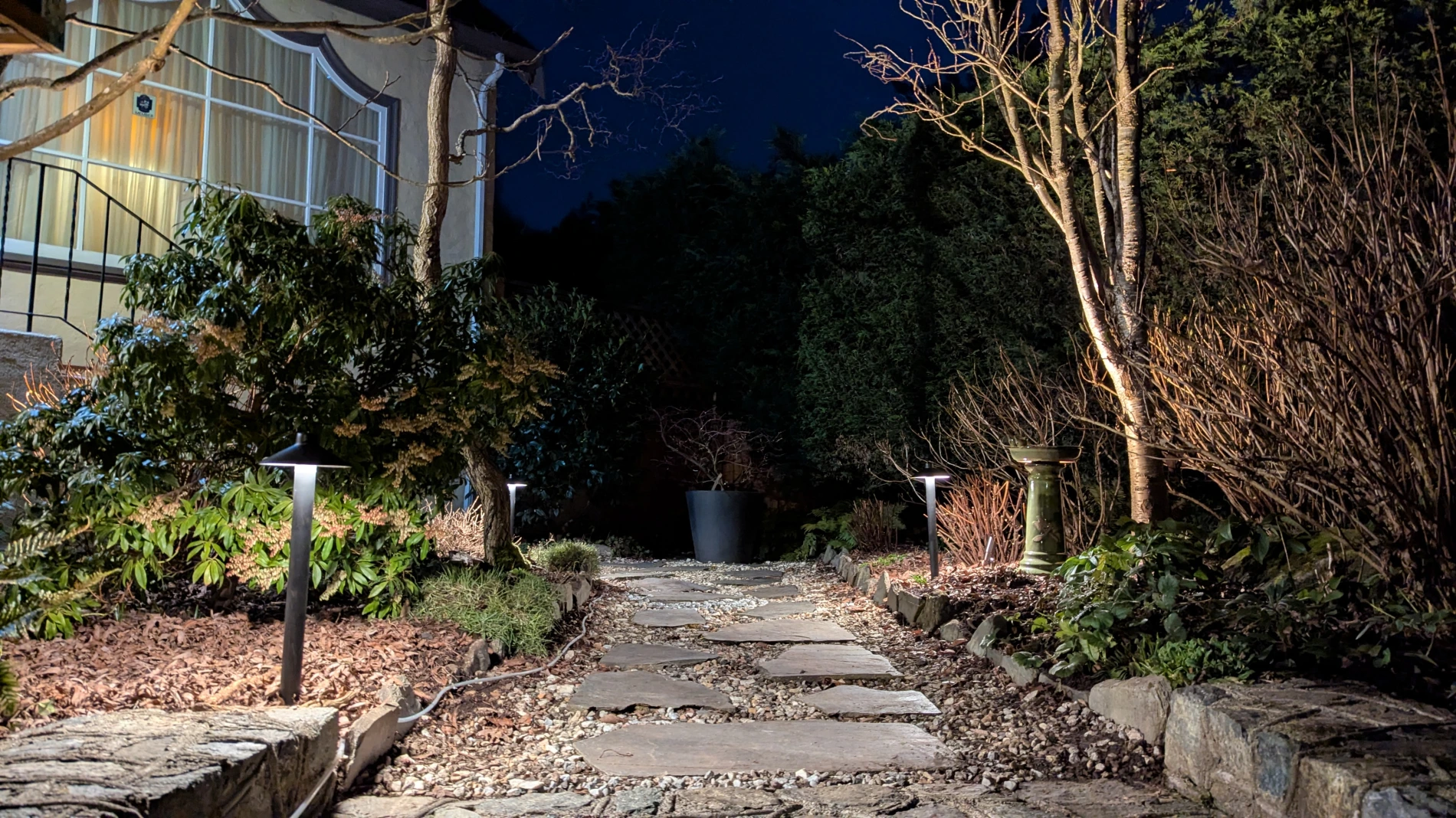
Path Lights Should Illuminate the Path, Not Become the Design
Path lights are useful around walkways, garden paths and transitions, but they can easily become too visually dominant.
A common mistake is installing identical fixtures directly opposite one another at perfectly repeated intervals.
The result can look like a runway.
We generally prefer to work with the shape of the pathway and surrounding landscape. Fixtures can be staggered so the pools of light overlap naturally without making the fixtures themselves the main feature.
Fixture height, glare control and light distribution matter here.
The goal is to understand where you are walking without feeling like every few feet has been marked by another bright object.
Well Lights Are Useful When You Want the Fixture to Disappear
Well lights sit flush or nearly flush with the surrounding grade.
They can work well in lawn areas, near hedges, beneath architecture or anywhere a stake-mounted fixture would be visually distracting or vulnerable to damage.
They are particularly useful where we want the effect of the light without seeing much of the fixture during the day.
The tradeoff is that they live in a demanding environment.
A recessed fixture may deal with soil, irrigation, standing moisture, leaves and landscape debris. Fixture construction, drainage and serviceability therefore become especially important.
A well light should not be selected only because it looks clean when installed.
It also has to survive where it is being placed.
Tree-Mounted Downlights and Moonlighting
Mature trees give us opportunities that ground-mounted fixtures simply cannot create.
A shielded downlight mounted high in a tree can produce a moonlighting effect, allowing light and shadow from branches to fall naturally onto the landscape below.
We may mount these fixtures roughly 25 to 30 feet high depending on the tree, access and effect we are trying to create.
The fixture needs good shielding because the goal is not to look up and see a bright light source.
Mounting method, cable routing and future serviceability matter just as much as the fixture itself.
On larger trees or difficult installations, specialized climbing access may also be required.
Tree lighting can be one of the most beautiful parts of a landscape lighting design, but it needs to be planned properly.
Driveway and Recessed Hardscape Fixtures
Driveways create a very different set of requirements.
A recessed fixture installed into concrete or pavers needs to tolerate a much harsher physical environment than a fixture sitting in a garden bed.
Installation may involve core drilling, precise layout and careful cable routing through existing hardscape.
The fixture itself should be selected for the application rather than simply using a standard landscape light because it physically fits.
The same principle applies to lighting integrated into stone walls, steps and other hardscape.
When done well, these fixtures almost disappear during the day.
That clean appearance is one reason hardscape lighting can cost considerably more to install. Our guide to landscape lighting costs in Victoria, BC explains those installation differences in more detail.
Step and Wall Lighting
Steps need enough light to make changes in elevation easy to understand without creating a bright source directly in someone’s eyes.
Depending on the structure, that might mean:
- compact recessed lights
- louvered fixtures
- integrated coping lights
- small downlights mounted nearby
The exact fixture matters less than where the light lands.
A poorly positioned step light can create glare while still leaving the walking surface difficult to read.
The goal is controlled, low-level illumination that helps people move through the space naturally.
Brass vs. Aluminum Landscape Lighting Fixtures
Fixture material matters, but the conversation is more nuanced than simply saying one material is “good” and another is “bad.”
We frequently use solid brass landscape lighting fixtures because brass performs extremely well outdoors and develops a natural patina rather than relying entirely on a painted finish.
That makes it particularly attractive for long-term installations in our climate.
But not every aluminum fixture is cheap.
High-quality aluminum fixtures designed for outdoor and marine environments can perform very well. Construction quality, coatings, seals, hardware and how the fixture is engineered matter.
The question should be:
Is this material and construction appropriate for where the fixture is being installed?
Not simply:
Is it brass or aluminum?
Integrated LED vs. Replaceable LED Lamps
There is no universal answer here either.
Replaceable LED lamps
A fixture with a replaceable LED lamp can offer excellent flexibility.
If the lamp eventually fails or you want to change the output, beam or colour temperature, the fixture itself may not need to be replaced.
That makes replaceable-lamp fixtures useful in many professional systems.
Integrated LED fixtures
Integrated fixtures allow the LED, optics and housing to be engineered together as one system.
That can provide very precise optical control, compact designs and more advanced control capabilities.
Higher-end integrated systems may also offer zoning, dimming, tunable white or RGBW colour control.
Neither approach is automatically better.
We use both depending on the application.
Serviceability matters just as much as technology.
How Much Light Do You Actually Need?
More output is not automatically better.
One of the easiest ways to make landscape lighting uncomfortable is to overpower the subject.
A small ornamental tree might need surprisingly little light.
A large canopy may require substantially more output or multiple fixtures.
Stone can respond dramatically to relatively low-output grazing light, while another surface might need a completely different approach.
We would rather start with enough light to reveal the subject and adjust from there than use excessive output everywhere.
Landscape lighting should create depth, not flatten the property.
What Colour Temperature Should Landscape Lighting Be?
For most Light Right landscape lighting designs, we generally start around 3000K warm white.
It gives us a warm appearance while still rendering landscaping, architecture and stone clearly.
That does not mean 3000K belongs everywhere.
A warmer 2700K can look beautiful around wood, heritage architecture or more intimate outdoor spaces.
Some contemporary properties may benefit from a slightly different approach.
Advanced systems can also provide tunable white light, allowing colour temperature to change depending on the application or time of evening.
And RGBW systems can add colour when desired while still providing a dedicated white channel for normal everyday lighting.
Colour temperature should support the property.
It should not be chosen simply because one number is currently popular.
What About Colour-Changing Landscape Lighting?
Colour can be useful when it is intentional.
RGBW fixtures can create completely different looks for holidays, events or entertaining while still providing quality white light for normal evenings.
On some properties, advanced colour control makes sense.
On others, it adds technology and expense without improving the everyday design.
We do not believe every premium landscape lighting system needs colour-changing fixtures.
Technology should serve the design, not become the design.
Glare Control Is Part of Fixture Selection
A fixture does not only need to illuminate the right subject.
It also needs to avoid illuminating your eyes.
Shielding, louvers, mounting location and aiming all help control glare.
This is especially important around:
- patios
- seating areas
- pathways
- large windows
- bedroom sightlines
- driveways
- elevated fixtures
A light can be technically perfect from one angle and extremely distracting from another.
That is why we consider where people will see the fixture from, not just what it is pointed toward.
Why We Do Not Use One Fixture Manufacturer for Everything
Different manufacturers are good at different things.
One company may make an excellent brass uplight. Another may offer better integrated control. Another may have a recessed fixture or optical option that fits a particular application better.
At Light Right, we work with professional manufacturers including Sterling Lighting, FX Luminaire, Lumien Pro, Kichler and WAC depending on what the project requires.
We are not trying to sell one catalogue.
We are trying to design the property.
That distinction matters.
What Should You Look for in a Professional Landscape Lighting Fixture?
When comparing fixtures, I would pay attention to more than appearance.
Look at:
- construction quality
- fixture material
- seals and weather resistance
- beam-angle options
- available output
- shielding and glare control
- adjustability
- LED and driver quality
- colour consistency
- serviceability
- warranty
- replacement parts
- control compatibility
And ask why that specific fixture was chosen.
A good designer should be able to explain what the fixture is doing in the design.
If the answer is simply, “That is the fixture we always use,” I would want to know more.
How Much Do Landscape Lighting Fixtures Affect the Total Cost?
Fixtures can be a significant part of the investment, but they are only part of the system.
Two projects using similar fixture counts may have very different costs because of transformers, controls, cable distance, hardscape, tree access, electrical work and installation complexity.
A recessed driveway fixture and an uplight installed in an open planting bed should not be expected to have the same installed cost.
That is why we do not believe price per fixture tells the entire story.
You can read the full breakdown in our guide to professional landscape lighting costs in Victoria.
Are Expensive Landscape Lighting Fixtures Worth It?
Sometimes.
But expensive is not the same thing as appropriate.
We would rather use a straightforward professional fixture that is exactly right for its job than an advanced fixture whose capabilities add no value to the design.
Premium technology starts to make more sense when the property benefits from things like:
- advanced optics
- precise dimming
- multiple control zones
- tunable white
- RGBW colour
- sophisticated automation
- difficult-to-access fixtures where reliability is particularly important
The right question is not:
“What is the most expensive fixture?”
It is:
“What does this location need?”
If you are deciding whether that level of investment makes sense for your property, read our guide to whether professional landscape lighting is worth it.
The Most Important Part Happens After the Fixture Is Installed
Even the right fixture can look wrong if it is poorly positioned or aimed.
Landscape lighting cannot be fully evaluated during the day.
Once darkness falls, we can see whether the beam is landing properly, whether output needs adjustment, whether glare is visible and how the fixture interacts with the rest of the property.
Sometimes a fixture needs to move.
Sometimes it needs a different optic.
Sometimes it needs to be dimmed.
And sometimes it needs to be removed.
Fixture selection gets us most of the way there. Night aiming finishes the design.
The Bottom Line
Choosing landscape lighting fixtures is not about finding one brand, one material or one technology that is always best.
It is about matching the fixture to the application.
The tree, pathway, driveway, architecture, garden and outdoor living space all have different requirements.
A good landscape lighting design uses those differences intentionally.
The fixtures should eventually disappear into the experience.
You should notice the tree.
The stone.
The path.
The architecture.
The way the property feels after dark.
Not the catalogue the fixtures came from.
If you want to see the kinds of problems poor fixture selection and installation can create, read our guide to common landscape lighting problems.
Considering Landscape Lighting for Your Property?
At Light Right, we design and install professional landscape lighting throughout Greater Victoria and Vancouver Island.
We select fixtures based on the property, the effect we want to create and how the system needs to perform over time.
Request a landscape lighting consultation with Light Right.